Outsiders often express admiration for Taiwan’s lively and diverse religious landscape. The authors of the most recent edition of Lonely Planet’s travel guide to the country are among those who paint a positive picture, enthusing: “Over the centuries the people have blended their way into a unique and tolerant religious culture… Taiwan is a country with many temples and many gods.”
Not every Taiwanese sees religion in a favorable light, however. Chen Lih-ming (陳立民), founder of the Taiwan Anti-Religion Alliance (台灣反宗教者聯盟), characterizes the country’s religiosity as “ridiculous.”
Chen isn’t concerned with how religious practices impact people’s physical health. His responses to this reporter’s questions make no mention of the air and noise pollution that temples often generate.
Nor does he talk about a widely-reported study conducted by National Taiwan University’s (NTU) College of Public Health almost 20 years ago. NTU researchers concluded that babies exposed to year-round incense-burning at home are 44 percent more likely to experience delayed gross motor development than children whose parents don’t burn incense.
“All religions are equally poisonous for society and for individual life. I think people come to religion for two reasons. One is the fear of death. Humans invent religions to ease that fear. Another is their bafflement as to the origin and structure of the universe,” says Chen, who used to teach university-level courses in thanatology, the interdisciplinary study of death.
After giving his students a grounding in modern astrophysics and how it explains the universe, Chen says, he told them that no historian can present evidence that Jesus returned to life after his crucifixion or that Buddha attained nirvana. “Some students challenged me, but after arguing they’d at least think I have reasons for my opinions,” he recalls.
Chen, who says he had a secular upbringing, is convinced there’s no life after death. Instead he believes “the only thing you have is your imperfect, uncontrollable, and limited life. Therefore you must cherish it. Buddhist teachings destroy your life, which is your only treasure.”
The retired lecturer — who’s contributed opinion pieces on politics to the Liberty Times under the pseudonym Chen Che (陳哲) — says that, while he was studying philosophy in Germany in the 1980s and 1990s, the decline of Christianity in Europe was obvious. But when he moved back, he was surprised to notice that Taiwan’s religious groups seemed to be prospering like never before.
Chen points out that, with the exception of continuing support for the death penalty, Taiwanese society seldom defies international trends. He goes on to suggest a few reasons why, well into the 21st century, religious identification and participation don’t seem to be declining here like they are throughout the West, in Japan, and in South Korea.
“Taiwanese people are by nature friendly and tolerant. Most of them would say that religions teach people to do the right thing. Secondly, Confucian influence might provide the soil in which faiths can develop,” he says.
What’s more, he argues, almost anyone can establish a Buddhist, Taoist, or folk place of worship. Unlike in Christian societies, where clergy are expected to undergo years of training, in Taiwan there’s no tradition of attending a religious academy.
“Some people see founding temples as a way to make money. They might consider opening a grocery store or a restaurant, but if they think a temple could bring in more money, they’ll start one,” he says, adding that some of “religious entrepreneurs” are dishonest from day one.
In Chen’s opinion, only when people behave correctly out of a sense of morality are their actions truly moral. “Doing good things because you’re promised paradise in the afterlife isn’t morality,” he says, labeling such behavior as heteronomy (nonmoral actions influenced by a force outside the individual; the opposite of autonomy).
Because the Bible is littered with heteronomous ideas, and asserts that only Christians have a chance of going to heaven, Christians see themselves as “God’s pets, with special privileges,” says Chen. “People expect fair treatment from God, but God cares more about membership than deeds. This is immoral.”
When heaven is his goal, “morality is only a tool or means,” says Chen, insisting that “many religious people use their privileges to do evil things.”
He adds that while Buddhism, Taoism, and popular (folk) religion agree that shan you shan bao (善有善報, “good deeds have good rewards” or “what goes around comes around”), “traditional Taiwanese religions lack clear heteronomous texts.” Nonetheless, their followers also worship deities because they believe they’ll gain some benefit. In his opinion, “Buddhists and Taoists are no less hypocritical” than Christians — and this is why he refuses to say that one faith is better or worse than another.
Chinese-language editions of books by three of “The Four Horsemen of New Atheism” — Richard Dawkins, Daniel Dennett, and Christopher Hitchens — have sold fairly well, but the writings of Sam Harris have yet to be translated for Taiwanese readers. And, so far, no local thinker has come up with a book-length critique of religion, Chen says.
Some ex-Buddhists and ex-Christians in Taiwan have published criticisms of those religions based on their own experiences, but in Chen’s opinion few of them know all of the weak points of those faiths, and they’re unable to tackle issues across the religious spectrum.
Chen is working on a book about thanatology, in which he’ll cover some aspects of religion. “I don’t know if there’s anyone in Taiwan who’s truly qualified to write a comprehensive anti-religion book and who plans to do so,” he says.
It’s going to be a while, it seems, before Taiwan has a Dawkins- or Hitchens-type public figure.
Anti-religion groups are active in many places. In English-speaking countries, humanist associations have grown in prominence. In Japan, the National Network of Lawyers Against Spiritual Sales assists victims of cults. The Federation of Indian Rationalist Associations coordinates the efforts of 83 organizations in the world’s most populous country.
No comparable body has yet emerged in Taiwan. Chen’s Taiwan Anti-Religion Alliance is currently a Facebook group with around 1,400 members. He’s not aware of any legal reasons why he couldn’t register an NGO with explicit anti-religion goals, he says. But neither does he expect any politicians to help his campaign.
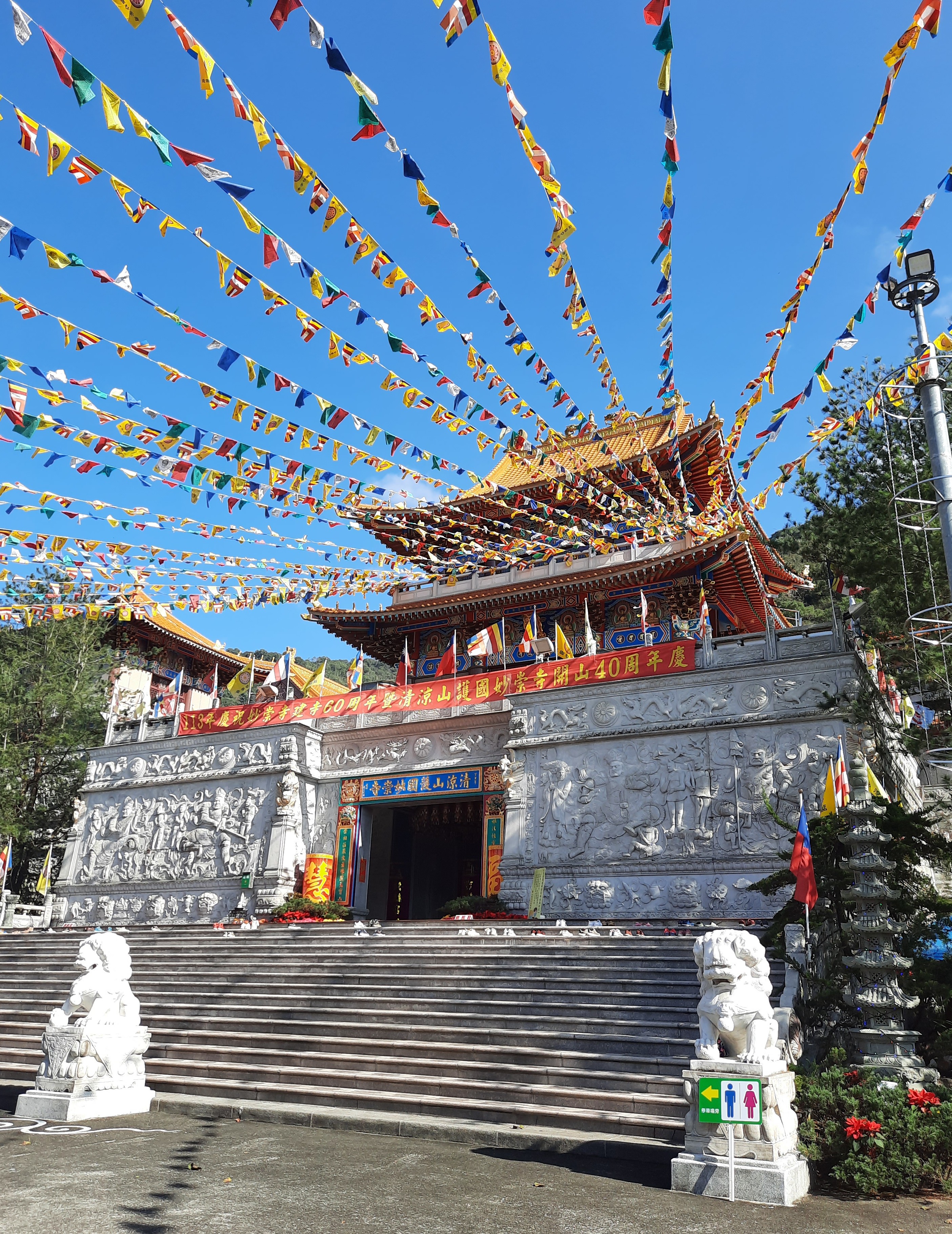
This was written as the first half of an intended two-part article, but the Taipei Times opted to run the second part only, which can be read here. I took the photo at Qingliangshan Huguo Miaochong Temple in Kaohsiung’s Liugui District.
 Steven Crook