The events he describes occurred more than half a century ago, but Jack Edwards has no difficulty recalling them. They were traumatic experiences in a small, densely forested valley just outside the Taipei suburb of Hsintien.
“We had to carry heavy rice steamers, bags of rice and other supplies up from the market to the camp,” he says. “It was six or seven miles each way. We had to carry dead men down on stretchers we made ourselves. And if we moved too slowly, the guards would beat us.”
Edwards, who grew up in Wales but has lived in Hong Kong since 1963, is currently in Taiwan on a tour of prisoner-of-war related sites with fellow British Army veterans John Marshall, Ben Gough, and James Scott, three Scotsmen who were captured by the Japanese Army in Singapore in 1942 and interned in Taiwan until the end of World War Two.
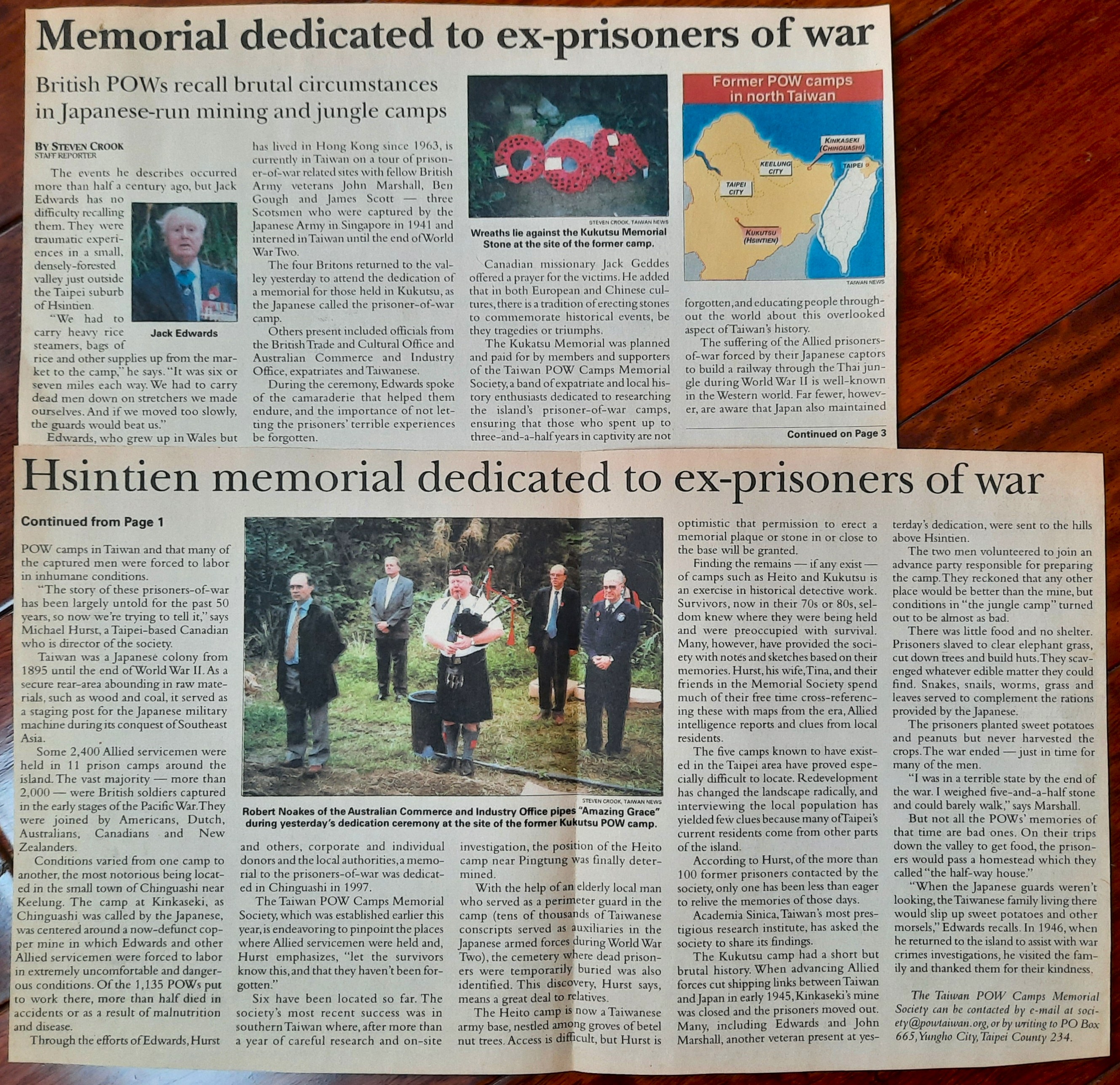
The four Britons returned to the valley yesterday to attend the dedication of a memorial for those held in Kukutsu, as the Japanese called the prisoner-of-war camp. Others present included officials from the British Trade and Cultural Office and Australian Commerce and Industry Office, expatriates, and Taiwanese.
During the ceremony, Edwards spoke of the camaraderie that helped them endure, and the importance of not letting the prisoners’ terrible experiences be forgotten.
Canadian missionary Jack Geddes offered a prayer for the victims. He added that in both European and Chinese cultures, there is a tradition of erecting stones to commemorate historical events, be they tragedies or triumphs.
The Kukatsu Memorial was planned and paid for by members and supporters of the Taiwan POW Camps Memorial Society, a band of expatriate and local history enthusiasts dedicated to researching the island’s prisoner-of-war camps, ensuring that those who spent up to three-and-a-half years in captivity are not forgotten, and educating people throughout the world about this overlooked aspect of Taiwan’s history.
The suffering of the Allied prisoners- of-war forced by their Japanese captors to build a railway through the Thai jungle during World War II is well-known in the Western world. Far fewer, however, are aware that Japan also maintained POW camps in Taiwan and that many of the captured men were forced to labor in inhumane conditions.
“The story of these prisoners-of-war has been largely untold for the past 50 years, so now we’re trying to tell it,” says Michael Hurst, a Taipei-based Canadian who is director of the society.
Taiwan was a Japanese colony from 1895 until the end of World War II. As a secure rear-area abounding in raw mate- rials, such as wood and coal, it served as a staging post for the Japanese military machine during its conquest of Southeast Asia.
Some 2,400 Allied servicemen were held in 11 prison camps around the island. The vast majority (more than 2,000) were British soldiers captured in the early stages of the Pacific War. They were joined by Americans, Dutch, Australians, Canadians and New Zealanders.
Conditions varied from one camp to another, the most notorious being located in the small town of Jinguashi near Keelung. The camp at Kinkaseki, as Jinguashi was called by the Japanese, was centered around a now-defunct copper mine in which Edwards and other Allied servicemen were forced to labor in extremely uncomfortable and dangerous conditions. Of the 1,135 POWs put to work there, more than half died in accidents or as a result of malnutrition and disease.
Through the efforts of Edwards, Hurst and others, corporate and individual donors and the local authorities, a memorial to the prisoners-of-war was dedicated in Jinguashi in 1997.
The Taiwan POW Camps Memorial Society is endeavoring to pinpoint the places where Allied servicemen were held and, Hurst emphasizes, “let the survivors know this, and that they haven’t been forgotten.”
Six have been located so far. The society’s most recent success was in southern Taiwan where, after more than a year of careful research and on-site investigation, the position of the Heito camp near Pingtung was finally determined. With the help of an elderly local man who served as a perimeter guard in the camp (tens of thousands of Taiwanese conscripts served as auxiliaries in the Japanese armed forces during World War Two), the cemetery where dead prisoners were temporarily buried was also identified. This discovery, Hurst says, means a great deal to relatives.
The Heito camp is now a Taiwanese army base, nestled among groves of betel nut trees. Access is difficult, but Hurst is optimistic that permission to erect a memorial plaque or stone in or close to the base will be granted.
Finding the remains, if any exist, of camps such as Heito and Kukutsu is an exercise in historical detective work. Survivors, now in their 70s or 80s, seldom knew where they were being held and were preoccupied with survival. Many, however, have provided the society with notes and sketches based on their memories. Hurst, his wife, Tina, and their friends in the Memorial Society spend much of their free time cross-referencing these with maps from the era, Allied intelligence reports and clues from local residents.
The five camps known to have existed in the Taipei area have proved especially difficult to locate. Redevelopment has changed the landscape radically, and interviewing the local population has yielded few clues because many of Taipei’s current residents come from other parts of the island.
According to Hurst, of the more than 100 former prisoners contacted by the society, only one has been less than eager to relive the memories of those days. Academia Sinica, Taiwan’s most prestigious research institute, has asked the society to share its findings.
The Kukutsu camp had a short but brutal history. When advancing Allied forces cut shipping links between Taiwan and Japan in early 1945, Kinkaseki’s mine was closed and the prisoners moved out. Many, including Edwards and John Marshall, another veteran present at yesterday’s dedication, were sent to the hills above Hsintien.
The two men volunteered to join an advance party responsible for preparing the camp. They reckoned that any other place would be better than the mine, but conditions in “the jungle camp” turned out to be almost as bad.
There was little food and no shelter. Prisoners slaved to clear elephant grass, cut down trees and build huts. They scavenged whatever edible matter they could find. Snakes, snails, worms, grass and leaves served to complement the rations provided by the Japanese.
The prisoners planted sweet potatoes and peanuts but never harvested the crops. The war ended-just in time for many of the men.
“I was in a terrible state by the end of the war. I weighed five-and-a-half stone and could barely walk,” says Marshall.
But not all the POWs’ memories of that time are bad ones. On their trips down the valley to get food, the prisoners would pass a homestead which they called “the half-way house.”
“When the Japanese guards weren’t looking, the Taiwanese family living there would slip up sweet potatoes and other morsels,” Edwards recalls. In 1946, when he returned to the island to assist with war crimes investigations, he visited the family and thanked them for their kindness.
Tidying up recently, I rediscovered the original print version of this 1,194-word feature I wrote for Taiwan News back in 2000 about a POW memorial in Xindian, New Taipei (then Taipei County’s Hsintien City). Jack Edwards died in 2006. As of early 2025, Micheal Hurst MBE remains director of Taiwan POW Camps Memorial Society.
 Steven Crook