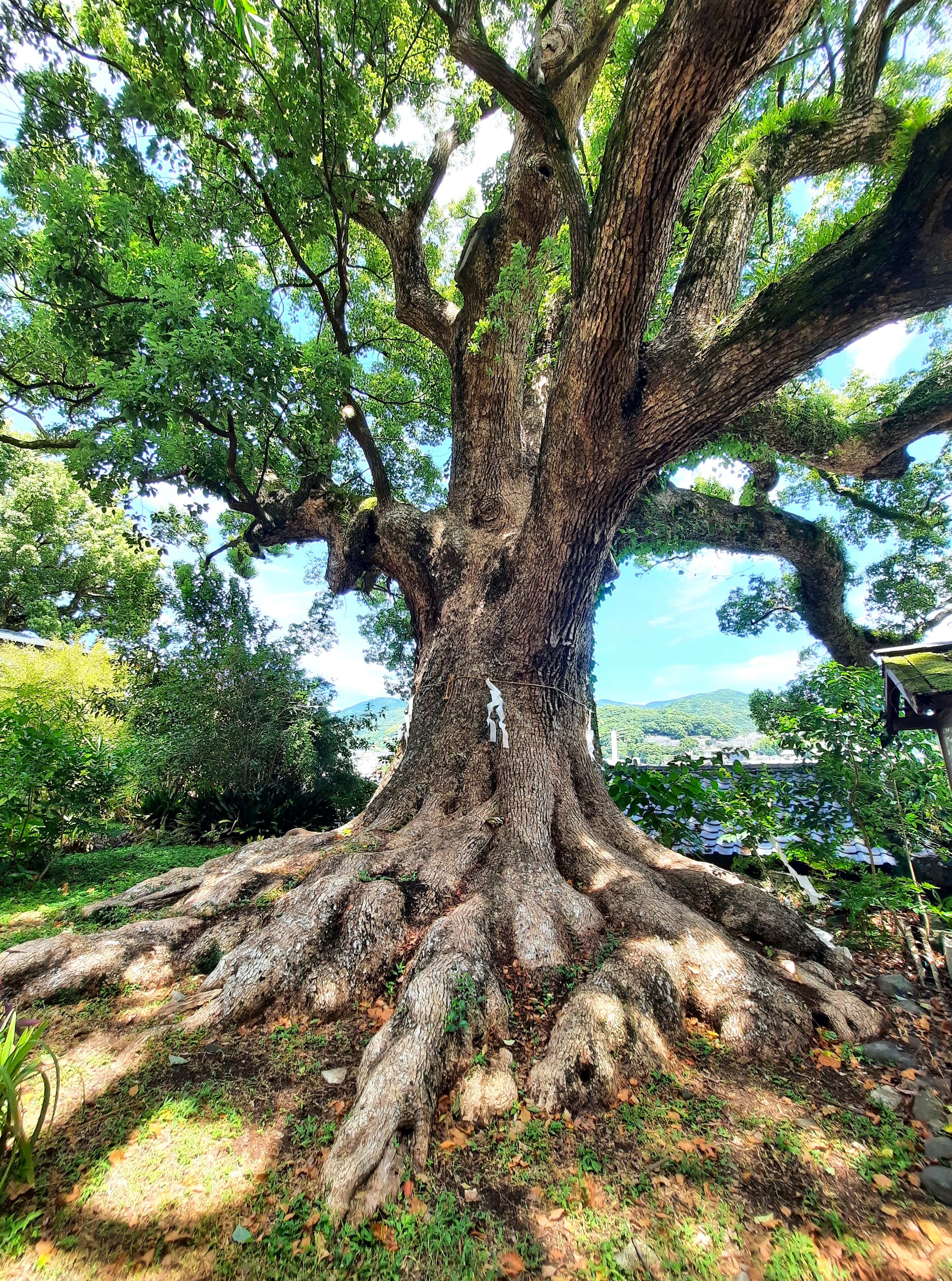
Taiwan is a realm of fantastic biodiversity. There are birds, frogs, snails, and freshwater fish found nowhere else on Earth. But for many of the pioneers venturing into the interior in the 18th and 19th centuries, these creatures were of no interest. They were searching for a particular tree species: Cinnamomum camphora, commonly known as the camphor laurel.
Camphor trees are found in various parts of East Asia, and the waxy aromatic solid that can be produced by steaming camphor-wood chips has long been popular as an ingredient in perfumes, an insect repellent, and a traditional medicine. Even now, many popular balms and decongestants are between 3 and 10% camphor. It was the essential ingredient in smokeless gunpowder, and is often burned during Hindu religious ceremonies.
For Chinese migrants spreading beyond Taiwan’s western lowlands, unexploited stands of Cinnamomum camphora were like seams of gold. For the various regimes that governed Taiwan between the late 17th and mid-20th centuries, however, the trade was too lucrative to ignore. In the 18th century, unauthorized felling warranted the death penalty. Soon after Japan took control of Taiwan in 1895, the Japanese colonial authorities established a state monopoly over camphor wood and oil.
Demand for camphor surged in the late 19th century, thanks in part to the invention of celluloid photographic film. At one point, the island was responsible for more than half of the world’s annual camphor production.
By 1911, however, another scientific breakthrough had undermined the state monopoly. Mass production of synthetic camphor was bad news for the colonial government’s finances, but ensured the survival of Taiwan’s remaining camphor groves.
Visitors to Taiwan who are curious to see Cinnamomum camphora trees and relics of the camphor industry needn’t go far out of their way. Even after the species had lost much of its economic value, the authorities continued to plant camphor trees to provide shade and stabilize slopes. Drought-tolerant when mature, they can thrive even during the long dry spells that are common during Taiwan’s winters.
To celebrate Kōki 2600 (the 2,600th year on Japan’s national calendar) in 1940, hundreds of families living in Nantou County’s Jiji Township were ordered to plant and nurture camphor saplings along what’s now designated Road 152.
Each tree was assigned to a particular household, and if the police noticed that a tree hadn’t been watered, they visited the head of the negligent household to remind, admonish, and sometimes punish. The policy was strict but successful. Nowadays, the 4.5-km-long “green tunnel” draws countless photographers and cyclists.
Throughout Taiwan, certain trees have been sanctified because of their age or size. Often, they’re associated with shrines dedicated to Tudi Gong, the local earth god. An especially impressive “sacred tree” stands at the heart of a tiny village half an hour’s drive from Jiji Green Tunnel.
The 26-m-tall Yongxing Giant Camphor, near Yongxing Elementary School in Shuili Township, is thought to be more than 300 years old. It’s accompanied by two of its descendants—sturdy trees in their own right—and all three are wrapped with cummerbund-like red sashes to symbolize their divinity.
If family or business commitments are keeping you close to Taipei, one of the best places to get in touch with Taiwan’s camphor heritage is Maokong in the southern part of the capital. While they don’t feature nearly so many camphor trees as Jiji Green Tunnel, Maokong’s Zhangshu (“Camphor Tree”) and Zhanghu (“Camphor Lake”) trails provide access to a highly appealing corner of the foothills.
As well as tremendous views, hikers can see wildflowers, a traditional piggery, and some of the farms that have made Maokong famous for its baozhong and other teas. The Zhangshu Path is a mere 1.2km in length, while the Zhanghu Path is twice as long. When combined with a ride in the cable car that connects Maokong to Taipei Zoo Metro Station, and a leisurely meal at a local teahouse, it’s very easy to spend an entire day here.
If you’re more interested in the process by which camphor trees were turned into valuable commoditiesoil, there’s no need to leave central Taipei.
National Taiwan Museum’s Nanmen Park campus occupies part of what was once the largest camphor-refining facility in the world. Within, an intriguing exhibition filled with models and multilingual information panels describes both the crude extraction method used in the early days by camphor teams in the foothills, and the scientific techniques adopted in the 20th century.
The former was labor intensive; men worked without machinery to reduce each tree to a pile of chips. The latter required far less human sweat, and yielded camphor oil of up to 99.8% purity.
Chinese-speaking travelers who make it to central Taiwan can learn about, and try their hand at, traditional camphor processing. In Taichung City’s Dongshi District, the Camphor Story Experience Hall displays antique equipment and offers various DIY experiences.
The hall belongs to a family firm that’s been making and selling camphor soaps and mosquito repellents since the industry’s heyday. Now that the public is embracing natural and artisanal products, it’s finding a new niche, and helping to bring the aroma of Taiwan’s treasure tree back to local households.
This article originally appeared in EVA Air’s inflight magazine in 2019. I took the photo in Nagasaki, Japan, last month.
 Steven Crook